
How to Improve Your Child’s Reading Comprehension: A Guide for Parents
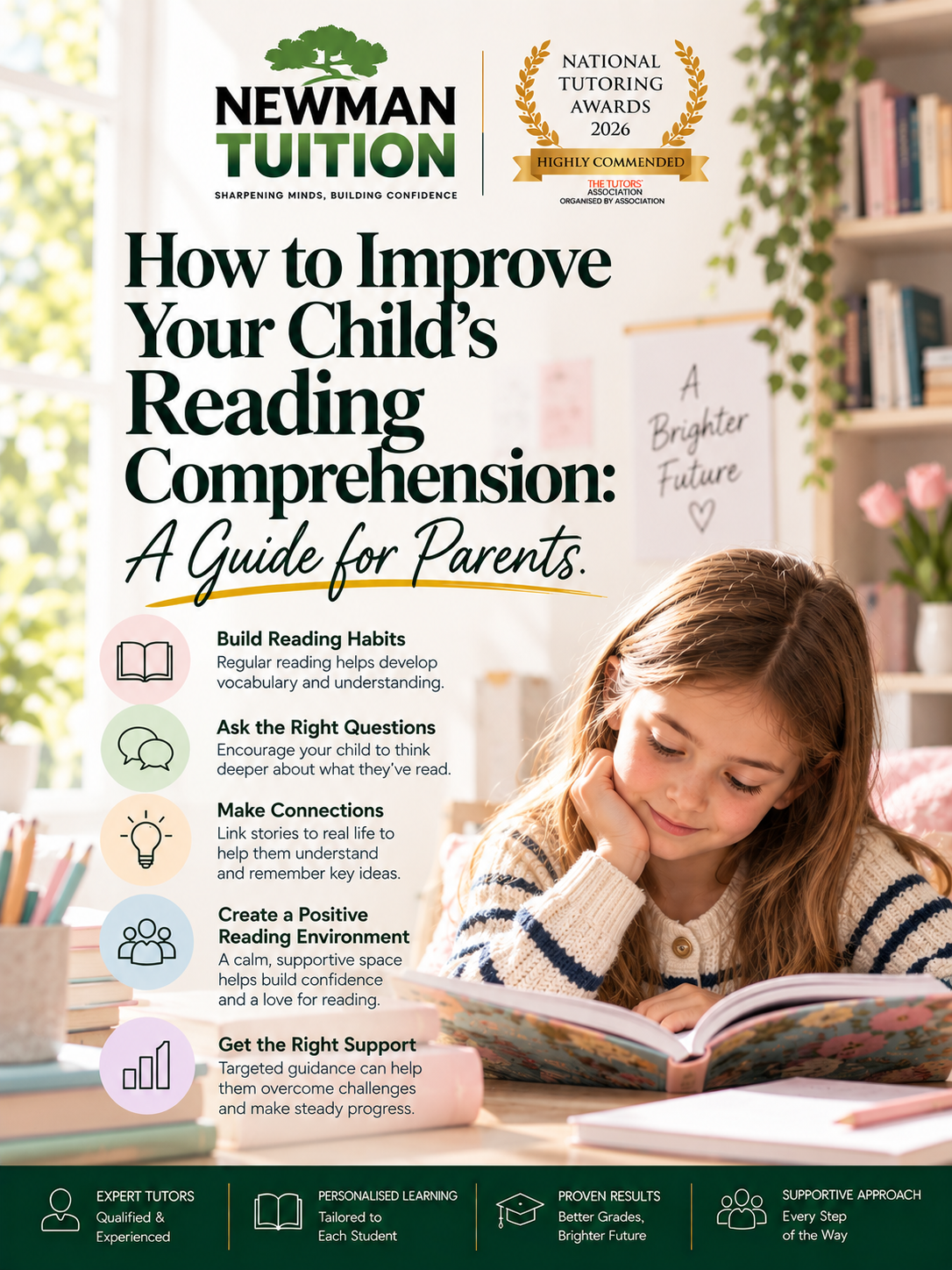
Reading comprehension is one of the most important skills children develop throughout their education. It involves much more than simply reading words on a page. Children need to understand what they have read, identify key information, interpret meaning and explain their ideas using evidence from a text.
Strong reading comprehension skills support learning across the curriculum, from answering English questions to understanding word problems in maths and interpreting information in science.
For parents, knowing how to help children improve their reading comprehension at home can make a real difference to their confidence and academic progress. The good news is that there are plenty of simple, practical ways to develop these skills through everyday reading.
1. Encourage Regular Reading
One of the most effective ways to improve reading comprehension is to make reading a regular part of your child’s routine.
Encourage your child to read a variety of materials, including fiction, non-fiction books, newspaper articles and age-appropriate online content. Exposure to different writing styles helps children develop their vocabulary, recognise different text structures and understand a wider range of ideas.
Try setting aside 10–20 minutes each day for reading, depending on your child’s age and attention span.
Allowing children to choose books that interest them can also help build motivation. Whether they enjoy adventure stories, animals, history or mysteries, reading should feel engaging rather than like another homework task.
For younger children, reading together and discussing the story can be particularly beneficial. As children become more confident, encourage them to read independently and explain what they have learnt.
2. Ask Questions About What They Have Read
Simply finishing a book does not necessarily mean a child has understood it. Asking questions encourages children to think more deeply about the text and demonstrate their understanding.
Start with straightforward questions before introducing more challenging ones.
For example:
- Retrieval: Who is the main character? Where does the story take place?
- Inference: How do you think the character is feeling? What clues tell you this?
- Prediction: What do you think might happen next? Why?
- Explanation: Why did the character make that decision?
- Evaluation: Did you enjoy the ending? Would you have changed anything?
Encourage your child to explain their answers rather than responding with just one word.
For example, instead of simply saying that a character is frightened, they could explain that the character is frightened because they are hiding, shaking or reacting nervously to a sound.
This helps children learn to support their answers with evidence from the text, an important skill for school assessments and entrance examinations.
3. Help Your Child Develop Their Vocabulary
A strong vocabulary makes it easier for children to understand what they read. Unfamiliar words can interrupt comprehension, particularly when a text contains descriptive language, complex sentences or subject-specific terminology.
When your child encounters a new word, encourage them to work out its meaning using the surrounding sentences.
You could ask:
- What do you think this word means?
- Which words in the sentence might give us a clue?
- Can you think of another word with a similar meaning?
- Can you use this word in your own sentence?
Keep a vocabulary notebook where your child can record new words, their meanings and examples of how to use them.
For children preparing for the 7+, 11+ or 13+ examinations, developing a broad vocabulary can be especially helpful when tackling unfamiliar texts and answering comprehension questions.
4. Teach Your Child to Read Between the Lines
Inference is the ability to work out information that an author has suggested without stating it directly.
This can be challenging because children need to combine clues from the text with what they already know.
For example, consider the sentence:
“Ella pulled her coat tightly around herself as she hurried down the empty street, glancing nervously over her shoulder.”
Ask your child what they can infer about Ella.
They might suggest that she is cold, worried or feels unsafe. Encourage them to identify the words that support their ideas.
Questions such as “What makes you think that?” and “Which part of the text gives you that impression?” help children understand that good answers are supported by evidence rather than guesswork.
Practising inference regularly can help children become more confident when reading stories, interpreting characters and answering more challenging comprehension questions.
5. Encourage Your Child to Summarise What They Have Read
Summarising helps children identify the most important information in a text rather than remembering every small detail.
After reading a chapter or passage, ask your child to explain what happened in their own words.
For younger children, this might involve describing the main characters and the key events. Older children can practise writing a short paragraph that captures the main idea and supporting details.
You could also ask them to summarise a passage in just three sentences.
This encourages them to distinguish between essential information and less important details, a skill that is particularly useful when answering comprehension questions under timed conditions.
6. Discuss Characters, Themes and the Author’s Choices
As children progress through school, reading comprehension increasingly involves analysing how a text has been written, not just understanding what happens.
Discussing characters, themes and the author’s language choices can help develop these analytical skills.
When reading fiction, consider questions such as:
- How does the author make this character seem interesting?
- Has the character changed throughout the story?
- What message do you think the author is trying to communicate?
- Why might the author have chosen this particular word?
- How does the setting influence what happens?
For non-fiction texts, encourage your child to identify the main argument, recognise facts and opinions, and consider the purpose of the writing.
These discussions help children become more thoughtful readers and prepare them for increasingly demanding English work.
7. Practise Reading Comprehension Questions
While reading for pleasure is important, practising structured comprehension questions can also help children prepare for classroom assessments and examinations.
Choose passages that are appropriate for your child’s reading level and gradually introduce more challenging texts.
Encourage your child to:
- Read the passage carefully before answering.
- Identify the key instruction in each question.
- Return to the text to find relevant evidence.
- Answer in full sentences when required.
- Check that their response addresses the question.
- Review mistakes and understand how to improve their answers.
If your child is preparing for the 7+, 11+ or 13+, familiarising them with the types of questions they may encounter can help them develop confidence and effective exam techniques.
It is important to focus on understanding as well as speed. Children need time to develop secure comprehension skills before they can apply them consistently under examination conditions.
8. Make Reading Fun and Interactive
Reading comprehension practice does not always need to involve worksheets or formal exercises.
You can build these skills into everyday activities in enjoyable ways.
Try these ideas at home:
- Story predictions: Pause before the end of a chapter and ask your child to predict what will happen next.
- Character interviews: Ask your child to pretend to be a character and explain their decisions.
- Book discussions: Compare your opinions about a story and explain why you agree or disagree.
- News detectives: Read an age-appropriate news article together and identify the key facts.
- Alternative endings: Ask your child to write a different ending while keeping the characters and events consistent with the original story.
These activities encourage children to think critically, communicate their ideas and engage more actively with what they read.
When Should You Consider Extra Reading Support?
Children develop reading comprehension at different rates, and occasional difficulties are a normal part of learning. However, if your child regularly struggles to explain what they have read, understand unfamiliar vocabulary, identify key information or answer questions about a text, additional support may be beneficial.
A tutor can help identify areas that need further development and provide structured opportunities to practise reading comprehension at an appropriate level.
Individualised support can be particularly useful for children preparing for SATs, the 7+, 11+ or 13+ examinations, where comprehension questions may require increasingly sophisticated reasoning and written answers.
The aim is not simply to complete more exercises, but to help children understand how to approach a text, interpret information and express their answers clearly.
Helping Your Child Become a Confident Reader
Improving reading comprehension takes time, practice and encouragement. By reading regularly, developing vocabulary, discussing texts and asking thoughtful questions, parents can help children build skills that support their education for years to come.
Remember that every child learns differently. Some children may need more time to develop their inference skills, while others may benefit from expanding their vocabulary or learning how to structure written answers.
Small, consistent steps can help children become more confident readers and more independent learners.
At Newman Tuition, we understand the importance of developing strong literacy skills. Our network of tutors supports children across a range of ages and educational stages, helping them strengthen their understanding and work towards their academic goals.
Looking for support with your child’s reading comprehension?
Get in touch with Newman Tuition to discuss your child’s learning needs and explore the tutoring options available.