What Is the Difference Between Year 10 and Year 11 GCSE Preparation?
GCSE preparation can feel overwhelming for students and parents, particularly when it is not always clear what should be prioritised and when. While Year 11 is often seen as the most important year for exam revision, the work students complete in Year 10 can have a significant impact on their confidence, understanding and final GCSE results.
Understanding the difference between Year 10 and Year 11 GCSE preparation can help students develop good study habits early, strengthen their subject knowledge and approach their final examinations with greater confidence.
So, what should students focus on in each year, and how can parents support them throughout the process?
Why Is Year 10 GCSE Preparation So Important?
Year 10 is when students begin studying a substantial proportion of their GCSE content. Although their final examinations may still feel a long way off, the knowledge and skills they develop during this year provide the foundation for Year 11 revision.
Effective Year 10 GCSE preparation is not about spending every evening revising for exams. Instead, it is about understanding topics as they are taught, identifying gaps in knowledge and developing independent learning habits that will become increasingly important as examinations approach.
Students should focus on:
- Understanding key concepts: Make sure new topics are understood before moving on to more advanced material.
- Consolidating classroom learning: Review notes regularly rather than relying on memory months later.
- Identifying areas of difficulty: Address challenging topics early instead of allowing gaps in understanding to grow.
- Developing exam technique: Become familiar with GCSE question styles, command words and mark schemes.
- Building consistent study habits: Establish a manageable revision routine alongside homework and other commitments.
By developing these habits in Year 10, students can enter Year 11 with a stronger foundation and a clearer understanding of what they need to improve.
What Should Students Focus on in Year 10?
The most effective approach to Year 10 GCSE preparation is to focus on learning, understanding and consistency rather than intensive last-minute revision.
1. Build Strong Subject Knowledge
Students should prioritise understanding the material covered in lessons. This includes being able to explain concepts in their own words, apply methods independently and recognise how different topics connect.
For example, in GCSE Maths, a student who struggles with fractions or algebra may find more advanced topics difficult later. In GCSE Science, gaps in understanding fundamental principles can make it harder to answer application-based questions.
Addressing these difficulties as they arise can prevent them from becoming larger obstacles in Year 11.
2. Review Topics Regularly
Leaving revision until the weeks before an examination can make the workload feel considerably more demanding.
Instead, students should revisit previous topics throughout Year 10. Short revision sessions, practice questions and self-testing can help reinforce learning and make it easier to recall information later.
Useful techniques include flashcards, retrieval practice, mind maps and completing questions without referring to notes.
3. Start Developing Exam Technique
Knowing the subject content is only part of achieving a good GCSE grade. Students also need to understand how to communicate their knowledge in the way examination questions require.
During Year 10, students can begin practising how to:
- Interpret command words such as describe, explain, compare and evaluate.
- Structure longer written answers clearly.
- Show working in mathematical questions.
- Use subject-specific terminology accurately.
- Manage their time when completing practice questions.
These skills develop through regular practice and feedback, rather than being mastered immediately before the final examinations.
4. Identify Weaknesses Early
Year 10 provides a valuable opportunity to identify subjects and topics that require additional attention.
Students should review marked assessments, homework feedback and practice questions to understand where they are losing marks. The aim is to establish why mistakes are happening and what needs to change.
For some students, this may mean revisiting foundational knowledge. Others may need more practice applying concepts, structuring answers or working under timed conditions.
Addressing these issues early allows students to make progress before the pressure of Year 11 increases.
How Does GCSE Preparation Change in Year 11?
Year 11 marks a shift from primarily learning and consolidating content towards preparing systematically for final examinations.
Students still need to understand new material taught during the school year, but revision becomes more structured and increasingly focused on applying knowledge independently.
The key priorities typically include the following.
1. Consolidating the GCSE Specification
By Year 11, students should be working towards a clear overview of the topics they need to know for each subject.
They can use the relevant exam board specification and teacher guidance to identify areas they understand confidently and topics that need further work.
This helps students avoid spending too much time revising familiar material while overlooking weaker areas.
2. Completing Past Papers and Exam Questions
Past papers and exam-style questions become increasingly important during Year 11.
They help students understand the format of examinations, practise applying knowledge and recognise the types of questions that may challenge them.
Students should also review their answers carefully. Simply completing a paper is less useful than understanding why marks were lost and practising how to improve.
Where appropriate, students should use official mark schemes and examiner guidance alongside feedback from their teachers.
3. Improving Time Management
As examinations approach, students need to become more confident working within time limits.
Timed practice helps them learn how long to spend on different questions, when to move on from a difficult problem and how to leave enough time to check their answers.
Students who have already developed exam technique in Year 10 may find this transition easier because they are building on familiar skills.
4. Following a Structured Revision Timetable
Year 11 revision should be planned around examination dates, subject priorities and individual areas of difficulty.
A useful timetable should include regular revision sessions, practice questions, time to review mistakes and breaks to support concentration.
The aim is not to revise every subject for the same amount of time. Instead, students should prioritise the topics where additional work is likely to make the greatest difference.
Year 10 vs Year 11 GCSE Preparation: What’s the Difference?
Although both years are important, the emphasis changes as students move closer to their examinations.
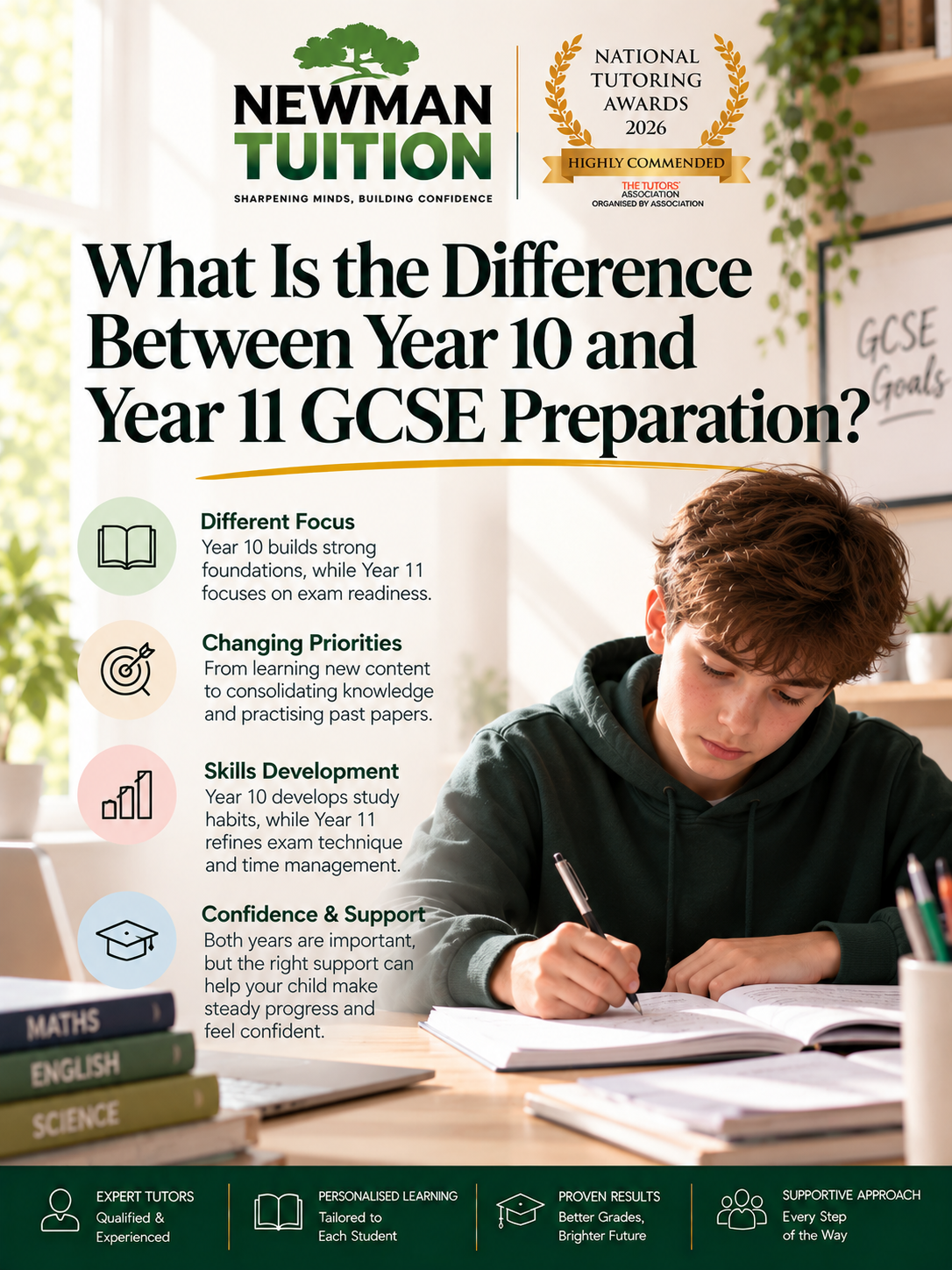
Area Year 10 Year 11 Main priority Building subject knowledge Consolidating knowledge and exam readiness Revision approach Regular review of recently taught topics Structured revision across the GCSE specification Exam practice Learning question styles and basic techniques More extensive exam-style questions and past papers Identifying weaknesses Finding and addressing knowledge gaps early Prioritising remaining weaknesses and improving performance Study habits Establishing consistent routines Following a focused revision timetable Main objective Creating a strong foundation Applying knowledge confidently in final examinations The most important distinction is that Year 10 is about preparing well for Year 11, while Year 11 is about bringing that preparation together and applying it successfully in examinations.
How Can Parents Support GCSE Preparation at Home?
Parents can play an important role in helping students stay organised and confident throughout Years 10 and 11.
Rather than focusing exclusively on grades, it is useful to encourage consistent effort, open communication and practical problem-solving.
Encourage Consistency Rather Than Last-Minute Revision
Help your child establish a realistic routine that fits around schoolwork, hobbies and rest. Short, regular revision sessions can be easier to maintain than lengthy sessions introduced only when examinations are approaching.
Talk About Difficult Subjects
Ask which topics your child finds challenging and whether they understand what is expected of them. Sometimes, a student may appear to be keeping up with schoolwork while quietly struggling with a particular concept.
Identifying these difficulties early creates an opportunity to seek help before they affect confidence or progress.
Review Feedback and Progress
School reports, assessments and mock examinations can provide useful information about strengths and areas for development.
Encourage your child to look beyond the overall grade and consider which specific skills or topics need attention. A disappointing result can become a practical starting point for improvement when the underlying issues are understood.
Seek Additional Support When Needed
If your child is consistently struggling with a subject, losing confidence or finding it difficult to work independently, additional academic support may be beneficial.
One-to-one tuition can provide opportunities to revisit challenging topics, ask questions and receive individual feedback at a pace suited to the student.
The earlier a difficulty is addressed, the more opportunity there may be to strengthen understanding before final examinations.
Can Starting GCSE Preparation in Year 10 Reduce Stress in Year 11?
Yes. Starting early can help reduce the amount of content students need to revisit from scratch in Year 11.
When students regularly consolidate what they learn, they are more likely to recognise familiar concepts during revision. This can leave more time for exam practice, improving weaker areas and building confidence.
Early preparation can also make the transition to Year 11 feel more manageable. Students who already understand their subjects, have effective study habits and know how to approach exam questions may feel better equipped to handle the demands of the final school year.
However, every student progresses differently. Some will need more support with subject knowledge, while others may benefit most from developing exam technique or improving their organisation. The key is to identify what each student needs and create a realistic plan.
How Can Tuition Help Students Prepare for GCSEs?
Some students benefit from additional support alongside their school lessons, particularly when they find certain topics difficult or need more individual attention.
Tuition can help students strengthen their understanding of challenging subjects, revisit foundational concepts and practise applying their knowledge to GCSE-style questions.
In Year 10, this support can focus on building confidence and addressing gaps before they become more difficult to resolve. In Year 11, tuition may become more targeted towards examination preparation, past-paper practice and improving performance in specific areas.
At Newman Tuition, support can be tailored to a student’s individual learning needs, helping them work towards their academic goals with a clearer understanding of what to focus on next.
Final Thoughts: Make the Most of Year 10 and Year 11
Successful GCSE preparation is not something that needs to begin a few months before the final examinations. It develops gradually through consistent learning, regular practice and a willingness to address difficulties as they arise.
Year 10 is the time to establish strong foundations, develop effective study habits and build subject knowledge. Year 11 is the opportunity to consolidate that learning, refine exam technique and prepare systematically for the examinations ahead.
By making the most of both years, students can approach their GCSEs with greater confidence and a more manageable revision workload.
If your child would benefit from additional academic support, Newman Tuition can help them strengthen their understanding, address learning gaps and prepare for their GCSE examinations with a more personalised approach.
Get in touch to discuss your child’s learning needs and explore the support available.
Frequently Asked Questions
When should students start preparing for GCSEs?
Students should begin developing effective study habits and consolidating subject knowledge in Year 10. More intensive, structured revision generally becomes a priority in Year 11, although the ideal approach depends on the student and their subjects.
Is Year 10 GCSE preparation really necessary?
Yes. Year 10 provides an opportunity to strengthen understanding, address learning gaps and develop exam technique before the final school year. Consistent preparation can make Year 11 revision more manageable.
How many hours should a Year 10 student revise?
There is no single number of hours that suits every student. Revision should be realistic, consistent and balanced with homework, school commitments and rest. Students should prioritise understanding and effective revision techniques over simply counting hours.
What should Year 11 students focus on most?
Year 11 students should consolidate the GCSE content, identify weaker topics, complete exam-style questions and practise managing their time. Their revision should reflect their individual needs and upcoming examination dates.
Can a tutor help with GCSE preparation in Year 10?
Yes. A tutor can help students understand challenging topics, strengthen foundational knowledge and develop effective study and exam techniques before they enter Year 11.
Is it too late to get help in Year 11?
No. Additional support can still be useful in Year 11, particularly when it focuses on specific knowledge gaps, exam technique and areas where the student can make meaningful progress. Starting earlier simply provides more time to address difficulties.