
Making Halloween Fun: Educational Games to Help Children Learn Through Play
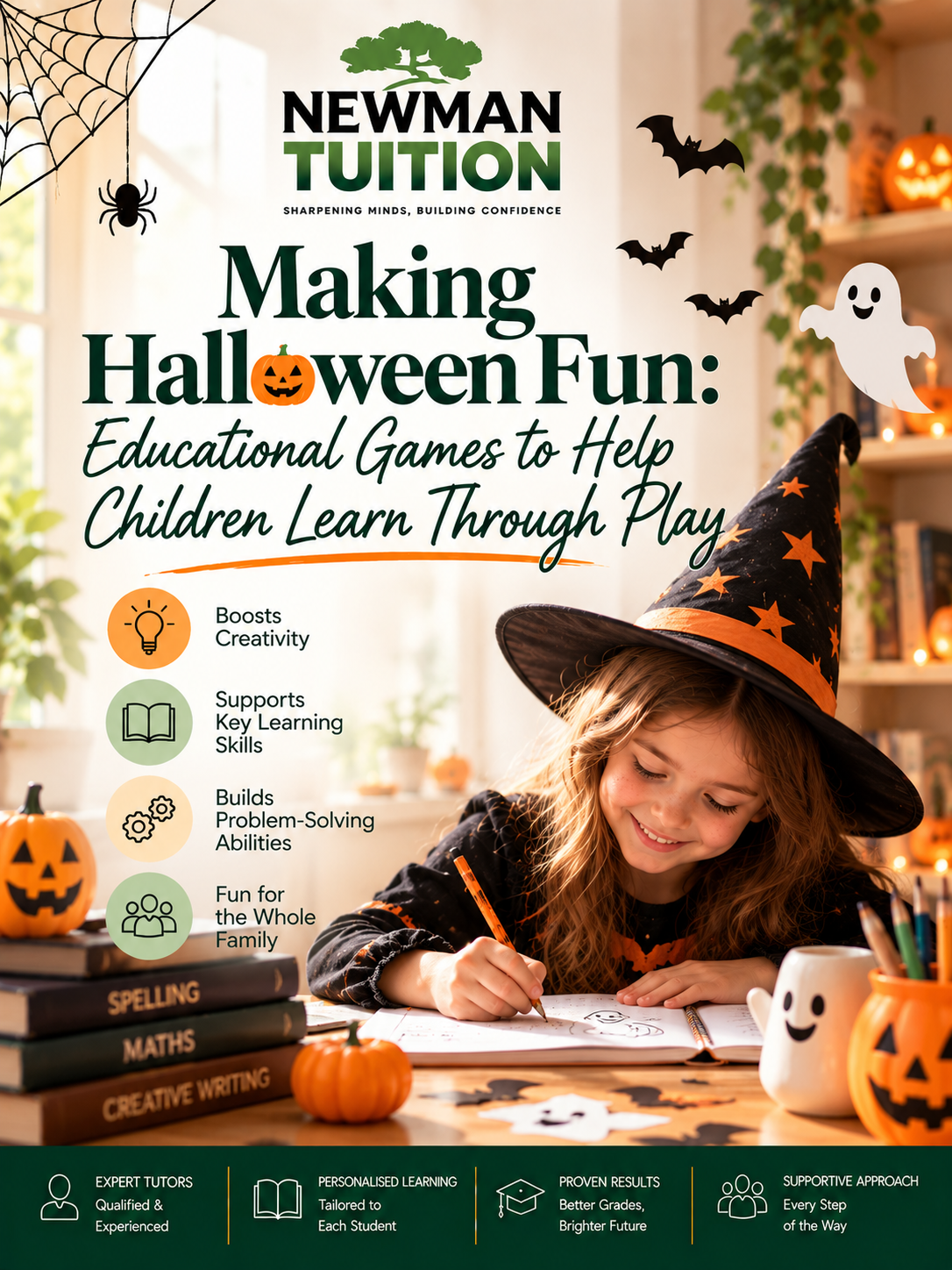
Halloween is the perfect opportunity to make learning exciting! With pumpkins, spooky stories, costumes and Halloween treats everywhere, October offers plenty of inspiration for educational activities that children will genuinely enjoy.
For parents looking to keep their children engaged outside the classroom, Halloween-themed learning games can be a brilliant way to practise important skills while embracing the excitement of the season. From spooky spelling challenges to pumpkin maths, learning does not have to feel like homework.
Here are some fun and educational Halloween games to try at home this October.
1. Spooky Spelling Challenges
Turn spelling practice into a Halloween adventure by creating a list of seasonal words. Think pumpkin, skeleton, haunted, witch, cauldron and Halloween.
Write each word on a separate piece of paper and place them inside a Halloween-themed container. Children can pick a word at random, spell it aloud, write it down or use it in a sentence.
What children learn: Spelling, vocabulary, writing and sentence construction.
Make it more challenging: Ask older children to write a short spooky story using five words from the list.
2. Pumpkin Maths
Maths becomes much more engaging when children can use familiar objects and colourful Halloween decorations.
Try these simple activities:
- Counting: Count sweets, toy spiders or mini pumpkins.
- Addition and subtraction: If a child has 12 Halloween sweets and gives away five, how many are left?
- Multiplication: Arrange plastic spiders into equal groups and calculate the total.
- Fractions: Divide a paper pumpkin into sections and ask children to colour in one-half, one-quarter or three-quarters.
You can easily adapt these activities to suit different ages and abilities, helping children build confidence with numbers through practical examples.
What children learn: Number recognition, mental arithmetic, problem-solving and fractions.
3. Create a Halloween Word Search
Word searches are a simple way to encourage children to practise reading and recognise spelling patterns.
Create a grid filled with Halloween words, such as ghost, vampire, monster, spider, bat and witch. Younger children can search for shorter words, while older pupils can tackle longer words or more complicated grids.
For an extra challenge, ask children to write a definition or a sentence for every word they find.
What children learn: Reading, spelling, concentration and vocabulary development.
4. Write a Spooky Story
Halloween is a wonderful opportunity to encourage creativity and develop writing skills.
Give children an opening sentence, such as:
“It was a dark and stormy Halloween night when I heard a strange noise coming from upstairs…”
Ask them to continue the story, introducing interesting characters, descriptive language and an unexpected ending.
You could also provide a selection of character, setting and object cards. Children pick one from each pile and must include all three in their story.
For younger children, encourage them to draw pictures and tell their story aloud before writing it down. Older children can focus on paragraphs, punctuation, expanded vocabulary and building suspense.
What children learn: Creative writing, grammar, punctuation, imagination and storytelling.
5. Halloween Treasure Hunt
An educational treasure hunt can turn an ordinary afternoon into an exciting learning adventure.
Hide clues around the house, with each clue requiring children to solve a question or complete a small challenge before moving to the next location.
For example:
- Solve a simple maths problem to discover the next clue.
- Unscramble a Halloween word.
- Answer a general knowledge question.
- Read a short riddle and work out where to look next.
You can tailor the difficulty to your child’s school year, making the activity suitable for a wide range of ages.
What children learn: Reading comprehension, logical reasoning, problem-solving and following instructions.
6. Design a Halloween Shop
Set up a pretend Halloween shop using toy money, price labels and Halloween-themed objects.
Give your child a budget and ask them to purchase different items without spending more than they have. They can calculate totals, work out change and compare prices.
For example, if a pumpkin costs £3, a witch’s hat costs £5 and a bag of sweets costs £2, can they buy all three items with £10?
For older children, introduce discounts, percentages or more complicated budgets.
What children learn: Money management, addition, subtraction, multiplication and real-world maths.
7. Halloween Science Experiments
Halloween also provides opportunities to explore science in a fun and memorable way.
Try simple, supervised experiments such as:
- Dancing raisins: Observe what happens when raisins are placed in sparkling water.
- Floating and sinking: Predict which Halloween-themed objects will float in water and test the results.
- Fizzing potions: Combine bicarbonate of soda and vinegar in a tray to observe a bubbling reaction, with adult supervision.
Encourage children to make predictions before each experiment and explain what they observe afterwards. Asking questions helps develop scientific thinking rather than simply following instructions.
What children learn: Observation, prediction, questioning and early scientific reasoning.
Always supervise experiments and check that the materials are age-appropriate.
Why Learning Through Play Matters
Children often engage more readily with activities that feel enjoyable and relevant to their interests. Educational games can provide opportunities to practise important skills without the pressure of a formal lesson or worksheet.
Learning through play can help children:
- Build confidence by practising skills in a relaxed setting.
- Develop problem-solving and independent thinking.
- Strengthen literacy and numeracy skills.
- Improve concentration and listening.
- Discover that learning can be enjoyable.
The key is to choose activities that are appropriate for your child’s age, school year and individual learning needs. Keep the atmosphere positive, celebrate their efforts and allow them to learn from mistakes.
Make This Halloween a Learning Adventure
Halloween does not have to mean putting learning on hold. With a little creativity, everyday activities can become opportunities to practise spelling, maths, reading, writing and problem-solving.
Whether your child is solving a spooky riddle, creating a monster-themed story or running their own Halloween shop, these activities can help make learning memorable while keeping the seasonal fun alive.
At Newman Tuition, we recognise that every child learns differently. Finding engaging ways to reinforce classroom learning can help children develop confidence, strengthen their understanding and approach new challenges with a positive attitude.
Looking for additional support with your child’s learning?
Discover how tailored tutoring can help your child build confidence and develop their academic skills. Get in touch with Newman Tuition to find out more about our tutoring options.