
Is Your Child Memorising or Actually Understanding What They Learn?
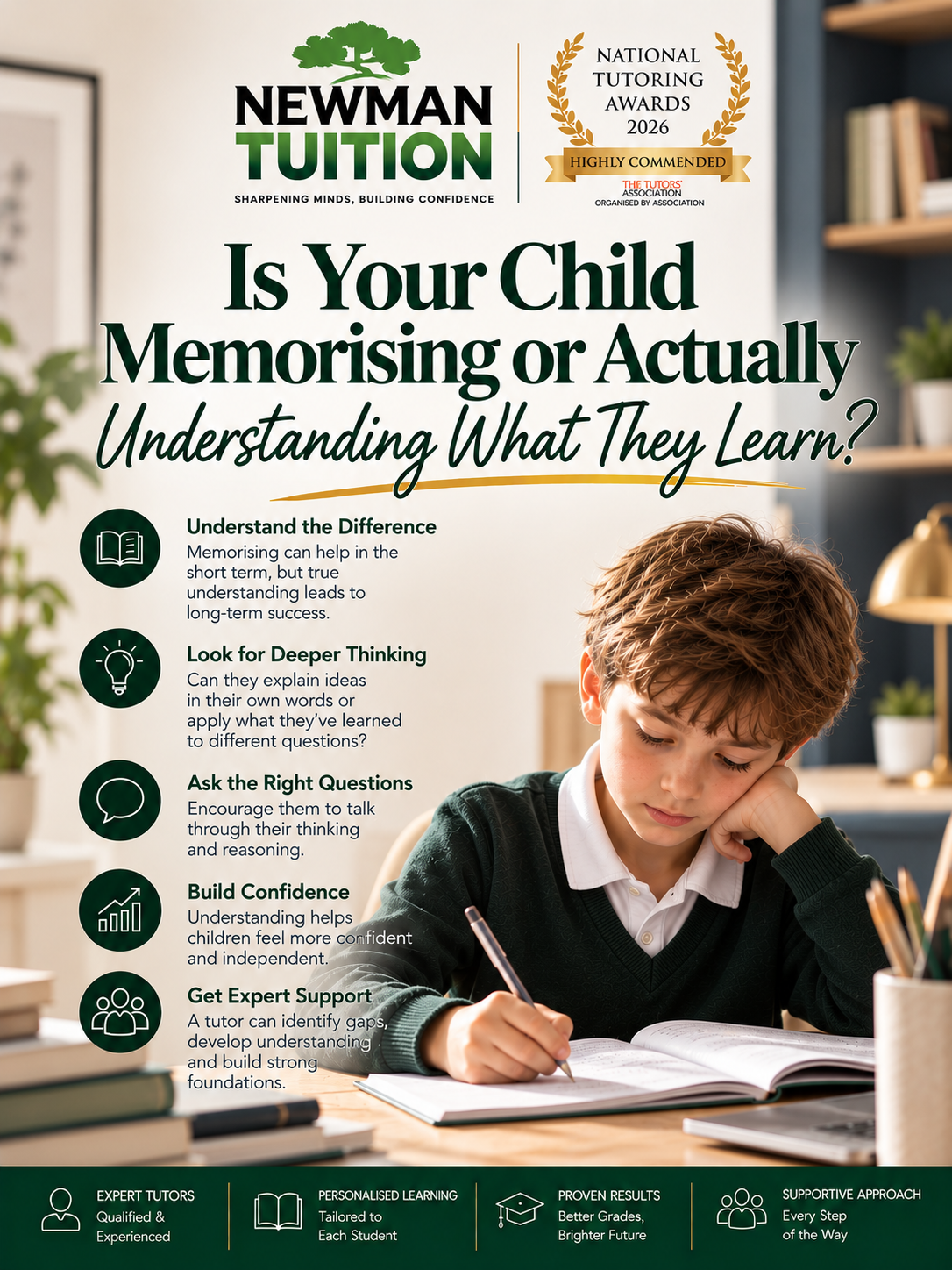
When children are revising for a test or preparing for an exam, it can be reassuring to see them working through notes, learning facts and completing practice questions.
But there is an important question parents may not always consider:
Is your child actually understanding what they are learning, or are they simply memorising information?
Memorisation is an important part of education. Children need to remember facts, vocabulary, formulas, dates and key information. However, being able to recall information does not necessarily mean that a child understands it.
True understanding allows children to apply what they have learned, explain it in their own words and use their knowledge when faced with a new or unfamiliar question.
What Is the Difference Between Memorising and Understanding?
Memorising involves remembering information so that it can be recalled when needed.
Understanding goes further.
A child who understands a topic should be able to explain the idea, make connections between different pieces of information and apply their knowledge to a new situation.
For example, a child may memorise that the answer to a particular maths question is 24.
But do they understand why the answer is 24?
Could they solve the same problem if the numbers were changed?
Could they explain the method to somebody else?
These are the kinds of questions that help reveal whether learning has gone beyond memorisation.
1. Can They Explain It in Their Own Words?
One of the simplest ways to check understanding is to ask your child to explain a topic without looking at their notes.
Try asking:
“Can you explain this to me as if I’ve never learned it before?”
If they can explain the concept clearly using their own words, this is a positive sign.
If they can only repeat sentences from a textbook or their revision notes, they may have memorised the information without fully understanding it.
You do not need to be an expert in the subject yourself. Listen to how confidently and logically your child explains the idea.
2. Can They Apply What They Have Learned?
Understanding becomes particularly important when children are asked to apply their knowledge.
A child might successfully answer a question they have practised several times, but what happens when the question is presented differently?
For example, in maths, they may know a particular method but struggle when the same skill is presented within a word problem.
In English, they may remember literary techniques but struggle to explain their effect within an unfamiliar text.
In science, they may remember a definition but struggle to explain how a scientific process works.
Being able to transfer knowledge to a different question is a strong indication of genuine understanding.
3. Can They Answer “Why?”
A child who understands a topic should usually be able to answer more than just “what?”
Encourage them to think about:
- Why does this happen?
- Why is this method used?
- Why is this answer correct?
- What would happen if something changed?
- How does this connect to something we have already learned?
These questions encourage deeper thinking rather than simple recall.
4. Can They Spot and Correct a Mistake?
Another useful way to assess understanding is to deliberately introduce an incorrect answer.
Ask your child:
“Do you think this answer is correct? Why?”
If they understand the topic, they may be able to identify the mistake and explain what should have happened instead.
This is a particularly useful skill because it requires children to think about the reasoning behind an answer rather than simply checking whether it matches what they have memorised.
5. Can They Use the Knowledge in a New Situation?
One of the biggest differences between memorisation and understanding is the ability to transfer knowledge.
Imagine your child has spent time learning about fractions.
Can they:
- Compare different fractions?
- Solve a word problem involving fractions?
- Explain what a fraction represents?
- Apply fractions to a real-life example?
- Work out an unfamiliar problem?
If they can only answer questions that look exactly like the ones they have practised, there may be a gap between memorisation and understanding.
Why Memorisation Still Matters
It is important to remember that memorisation is not a bad thing.
In fact, it is an essential part of learning.
Children need to memorise multiplication tables, spelling rules, vocabulary, formulas and key facts.
The problem occurs when memorisation becomes the only learning strategy.
A strong learner needs both recall and understanding.
For example, a GCSE student may need to remember a scientific formula. But they also need to understand what the formula means, when to use it and how to apply it to an unfamiliar question.
The strongest learning combines both.
Signs Your Child May Be Relying Too Heavily on Memorisation
There are several signs that your child may be learning information without fully understanding it.
You may notice that they:
- Can recite information but struggle to explain it
- Perform well on familiar questions but struggle with unfamiliar ones
- Forget information soon after a test
- Become stuck when a question is worded differently
- Rely heavily on revision cards without understanding the concepts
- Find it difficult to make connections between topics
- Become frustrated when they cannot remember the exact wording of something
- Struggle to explain why an answer is correct
None of these automatically mean your child has a learning difficulty.
They may simply need to change the way they approach revision and learning.
How Can Parents Encourage Deeper Understanding?
You do not need to sit down and teach every subject yourself.
Small changes to the way you talk about learning can encourage your child to think more deeply.
Instead of asking:
“What’s the answer?”
try asking:
“How did you work that out?”
Instead of:
“Have you learned this?”
ask:
“Can you explain it to me?”
Instead of:
“Did you get it right?”
ask:
“Why do you think that answer is correct?”
These simple questions encourage children to focus on their thinking rather than just the final answer.
Try the “Teach It Back” Method
One particularly useful technique is asking your child to teach the topic back to you.
Choose something they have recently learned and ask them to explain it as though they are the teacher.
They should try to:
- Explain the main idea.
- Give an example.
- Explain why it works.
- Answer questions about it.
- Show how they would apply it to a new problem.
If they can confidently do all five, they are likely demonstrating a good level of understanding.
If they become stuck, you have identified an area that may need to be revisited.
Understanding Is Particularly Important Before Exams
As children move towards important examinations such as GCSEs and entrance exams, simply memorising large amounts of information becomes increasingly difficult.
Exam questions are often designed to test whether students can apply, analyse and evaluate what they have learned.
This means students need to be able to think beyond the information they have memorised.
Good revision should therefore include a mixture of:
- Active recall
- Practice questions
- Explaining concepts
- Applying knowledge
- Reviewing mistakes
- Revisiting difficult topics
- Practising unfamiliar questions
The aim should not simply be to remember more.
It should be to understand more deeply.
What If Your Child Understands the Topic at Home but Struggles in Tests?
This is another common situation.
A child may be able to explain a topic perfectly when sitting at home but struggle to demonstrate their understanding under test conditions.
This could be related to several factors, including exam technique, time management, question interpretation or confidence.
In these situations, practising exam-style questions can help bridge the gap between understanding a topic and successfully demonstrating that understanding in an assessment.
Building Stronger, More Independent Learners
The ultimate goal of education is not simply for children to remember information long enough to pass a test.
It is to help them become confident, independent learners who understand how to use the knowledge they have developed.
When children understand why something works rather than simply remembering what the answer is, they are better equipped to tackle unfamiliar problems, make connections between subjects and retain their learning for longer.
Parents can play an important role by encouraging curiosity and asking questions that make children think.
And if your child is struggling to move from memorising information to genuinely understanding a topic, additional academic support can help.
At Newman Tuition, personalised tuition can give children the opportunity to revisit challenging concepts, ask questions, develop stronger learning strategies and build confidence in their ability to apply what they know.
Because the goal isn’t simply to help your child remember the answer.
It’s to help them understand how they got there.