
11+ Preparation: What Should Your Child Be Working On in October?
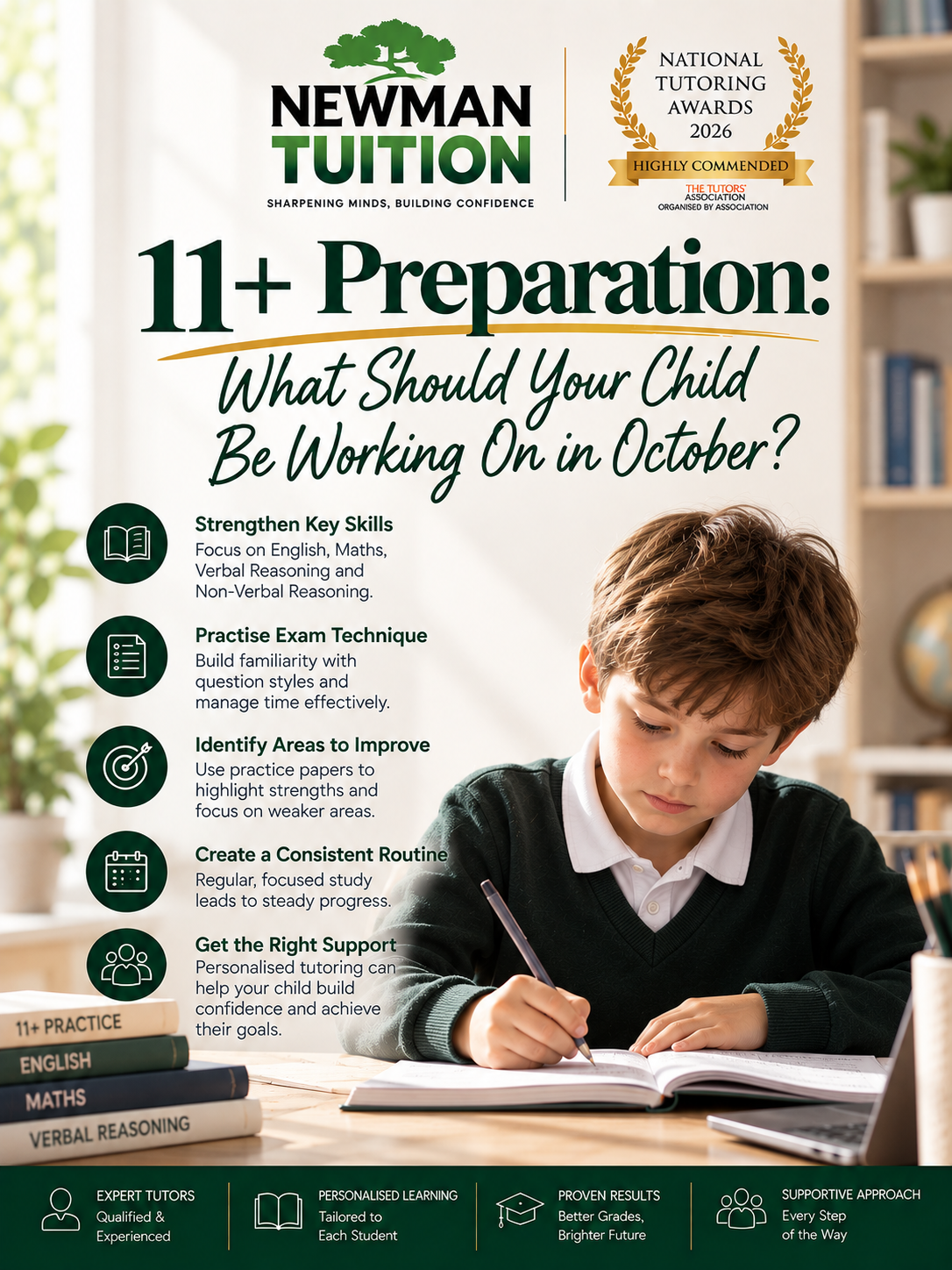
October can be an important point in the 11+ preparation journey. The new school year is underway, children have had time to settle into their routines, and parents may be starting to think more seriously about entrance exams and the skills their child needs to develop.
While every child’s 11+ journey is different, October is a useful time to review progress, identify any areas that need additional support and make sure preparation is developing at the right pace.
So, what should your child be working on at this stage?
Understanding What the 11+ Involves
Before focusing heavily on practice papers and timed tests, it is important that your child understands the types of skills they may be assessed on.
Depending on the school and examination provider, the 11+ can include areas such as:
- English
- Mathematics
- Verbal reasoning
- Non-verbal reasoning
- Reading comprehension
- Vocabulary
- Spelling and grammar
- Problem-solving
- Logical thinking
The exact format varies between schools, so it is important to understand the requirements of the schools your child is applying to.
October is a good time to make sure your preparation plan reflects the relevant examination format rather than simply completing generic 11+ worksheets.
1. Strengthen Core Maths Skills
Strong mathematical foundations are an important part of 11+ preparation.
By October, your child should be developing confidence with key areas such as:
- Fractions, decimals and percentages
- Multiplication and division
- Long multiplication and division
- Word problems
- Ratio and proportion
- Measurement
- Geometry
- Mental arithmetic
- Problem-solving
It is not simply about knowing how to complete a calculation. Many 11+ questions require children to understand what a question is asking, identify the relevant information and decide which method to use.
Encouraging your child to explain how they reached an answer can therefore be just as valuable as getting the correct answer.
2. Develop English and Reading Skills
Reading is one of the most useful ways to support broader 11+ preparation.
Encourage your child to read regularly and expose them to a variety of books and writing styles.
Alongside reading for enjoyment, work on skills such as:
- Reading comprehension
- Vocabulary
- Spelling
- Grammar
- Punctuation
- Inference
- Identifying key information
- Understanding unfamiliar words
- Summarising passages
When reading together, ask questions about the text rather than simply asking your child to tell you what happened.
For example:
“Why do you think the character behaved that way?”
“What does this word mean in the context of the sentence?”
“What evidence in the passage supports your answer?”
These questions encourage children to think beyond simply recalling information.
3. Build Vocabulary
A strong vocabulary can benefit children across several areas of the 11+.
Children may encounter unfamiliar words in reading comprehension, verbal reasoning and English questions, so gradually expanding their vocabulary can be very useful.
Rather than trying to memorise hundreds of words at once, make vocabulary part of everyday learning.
When your child comes across an unfamiliar word:
- Look at the sentence it appears in.
- Ask your child what they think it might mean.
- Look up the definition together.
- Discuss similar and opposite words.
- Encourage them to use the new word in their own sentence.
Over time, this can help children become more confident when faced with unfamiliar language.
4. Introduce or Develop Verbal Reasoning
Verbal reasoning involves using language, words and logic to solve problems.
Questions can involve activities such as identifying relationships between words, finding similarities or differences, completing sequences and working with codes or letters.
If verbal reasoning is part of your child’s examination, October is a good time to identify which question types they are comfortable with and which require more practice.
The goal should not simply be to complete as many questions as possible. Understanding why an answer is correct is essential.
5. Practise Non-Verbal Reasoning
Non-verbal reasoning focuses on shapes, patterns, diagrams and visual relationships rather than traditional written language.
Children may need to identify patterns, complete sequences, recognise transformations or determine which shape comes next.
These questions can initially feel unfamiliar, particularly if a child has not encountered them before.
Regular, manageable practice can help children become familiar with the different question types and develop strategies for approaching them.
6. Start Developing Time Management
As preparation progresses, children will eventually need to become comfortable working within a set amount of time.
However, October does not necessarily need to be about completing full papers under strict exam conditions every week.
Instead, begin gradually introducing timed activities.
For example, you could give your child a small group of questions and encourage them to complete them within a realistic time limit.
This helps develop an awareness of pace without making every practice session feel like an examination.
As your child becomes more confident, timed practice can become more challenging.
7. Identify Areas That Need Improvement
One of the most valuable things you can do during 11+ preparation is identify where your child needs support.
A child might be strong in Maths but struggle with reading comprehension. Another child might understand the work but lose marks because they work too quickly and make avoidable mistakes.
Look for patterns in their work.
Are they consistently making mistakes with fractions?
Do they struggle to understand longer passages?
Are they running out of time?
Do they understand the question but struggle to explain their answer?
Are they making mistakes because they are rushing?
Identifying these patterns allows preparation to become much more targeted.
8. Work on Accuracy Before Speed
It can be tempting to focus heavily on completing questions quickly, particularly as the 11+ approaches.
However, accuracy should come first.
If your child is regularly making mistakes because they are rushing, increasing their speed may simply lead to more incorrect answers.
Focus initially on helping them understand the question, choose the correct method and check their work.
Once accuracy improves, speed can gradually be developed through timed practice.
9. Develop Exam Technique
11+ preparation is not only about academic knowledge. Children also need to understand how to approach an examination.
This can include learning how to:
- Read questions carefully
- Identify key information
- Eliminate incorrect answers
- Check work
- Manage time
- Move on from difficult questions
- Return to questions when appropriate
- Stay focused throughout an assessment
These are skills that can be developed gradually rather than left until the weeks immediately before the exam.
10. Keep Preparation Consistent
Perhaps the most important part of 11+ preparation is consistency.
Short, regular sessions are often easier for children to manage than occasional long periods of intensive work.
Your child’s routine might include:
- Regular reading
- Maths practice
- English and comprehension activities
- Verbal reasoning
- Non-verbal reasoning
- Vocabulary development
- Occasional timed practice
The exact balance will depend on your child’s current ability and the requirements of their chosen schools.
The aim is to create a routine that is challenging enough to make progress but manageable enough to maintain throughout the year.
Don’t Forget Confidence
11+ preparation can sometimes become heavily focused on scores, marks and practice papers.
But confidence matters too.
Children are more likely to perform at their best when they feel prepared and understand how to approach unfamiliar questions.
Celebrate progress, not just high scores. If your child has improved from struggling with a particular topic to answering those questions independently, that is meaningful progress.
Try to avoid making every practice session feel like a test. Reading, puzzles, mental maths games and discussions can all support the development of useful skills without adding unnecessary pressure.
Is October the Right Time to Get Additional Support?
For some children, independent preparation and support at home may be enough. For others, additional tuition can provide structure, targeted practice and a clearer understanding of where they need to improve.
An 11+ tutor can help assess your child’s current strengths and weaknesses, create a personalised preparation plan and gradually develop the academic and exam skills they need.
The benefit of identifying areas for improvement in October is that there is still time to work on them steadily rather than trying to address everything shortly before the examination.
Preparing for the 11+ Is a Journey
There is no single preparation plan that works for every child.
Some children may need to strengthen their Maths foundations, while others may benefit from additional reading comprehension, vocabulary or reasoning practice. The most effective preparation is usually tailored to the individual child and the requirements of the schools they are applying to.
October is therefore a valuable opportunity to step back, review progress and ask:
What is my child already doing well?
Where are they losing marks?
Which skills need more development?
Are they becoming more confident with unfamiliar questions?
Are they progressing at the right pace?
With a consistent approach and the right support, preparation can become a positive part of your child’s academic journey rather than something that only becomes stressful as the examination gets closer.
Looking for 11+ Tuition?
Newman Tuition provides personalised tuition to support children preparing for school entrance examinations, including the 11+. Sessions can be tailored around your child’s individual needs, helping them develop their academic knowledge, reasoning skills, exam technique and confidence.
To find out more about 11+ tuition and how we can support your child, get in touch with Newman Tuition today.